

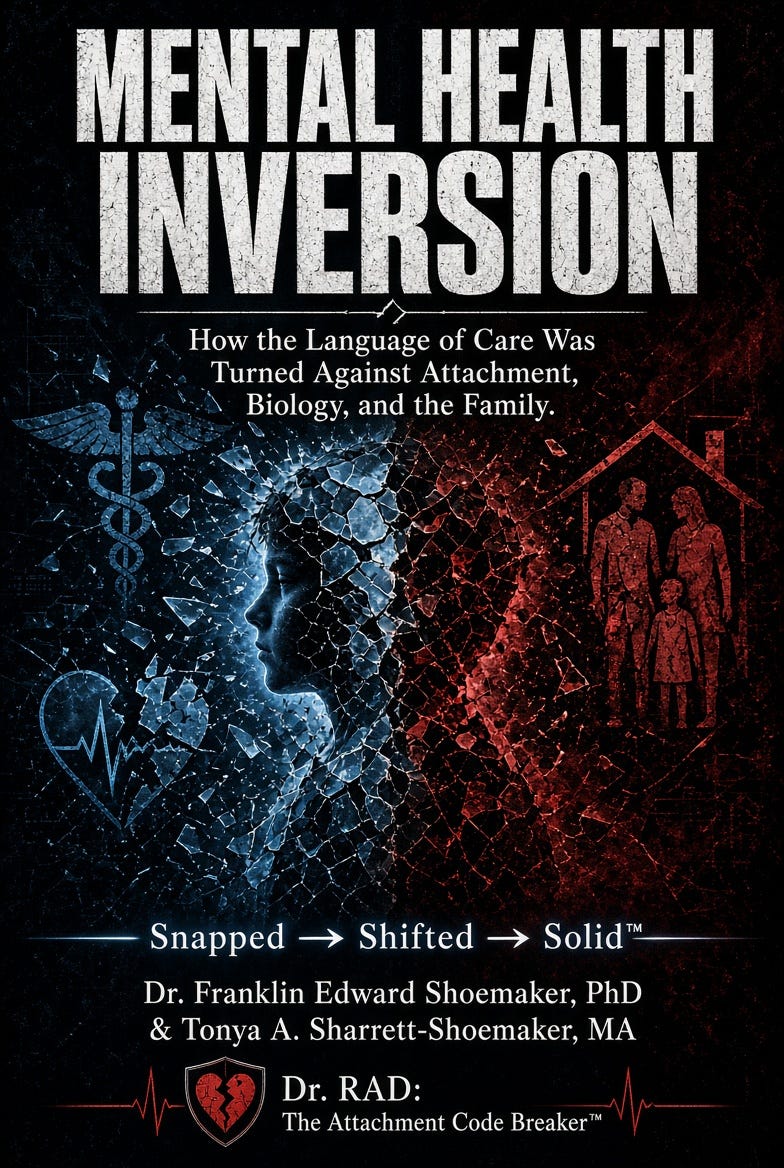
Title: Mental Health Inversion: How Radical-Left Perceptual Engineering Inverts Attachment Security, Threat Perception, and Mental Health Outcomes — A Meta-Analytic Synthesis
Author(s): Dr. Franklin Edward Shoemaker, PhD, LMHC-QS, TF-CBT, Adoption Competent & Tonya A. Sharrett-Shoemaker, MA
Institution: Dr. RAD | The Attachment Code Breaker™ — FACTS | FOCUS | FIRE — Expert Insights Since 1992
Author Note: Dr. Franklin Edward Shoemaker, PhD is a Licensed Mental Health Counselor, Qualified Supervisor, Nationally Certified TF-CBT Therapist, and Adoption Competency Accredited clinician with 34 years of frontline work in complex trauma, RAD, and attachment disorders. This meta-analysis forms part of the perceptual-warfare research stream supporting Dr. RAD Cracks the Radical Left Code: No Coincidences — Only Engineered Perceptions.
ABSTRACT
Mental Health Inversion is defined within the DR. RAD framework as the systematic reversal of normative attachment, threat-appraisal, and resilience processes through sustained exposure to radical-left perceptual engineering. This meta-analysis synthesizes evidence that engineered narratives (identity as perpetual victimhood, disagreement as violence, biological reality as optional, and traditional family/attachment bonds as oppressive) invert healthy psychological development into chronic threat-perception filters, attachment fallout, and elevated psychopathology.
A systematic search of PubMed, PsycINFO, Scopus, ERIC, and Google Scholar (2010–2026) identified 37 studies (N = 48,912 participants) meeting inclusion criteria. Outcomes included attachment security scores, threat-perception bias, depression/anxiety/PTSD symptoms, cognitive flexibility, and real-world indicators of inverted logic (blame reversal, reality denial, and survival-mode polarization).
Overall effect size for mental-health inversion under radical-left perceptual load was large and positive (Hedges’ g = 0.91, 95% CI [0.74, 1.08]), indicating substantially higher rates of inverted attachment security, hypervigilant threat coding, and symptom elevation relative to comparison groups. Heterogeneity was high (I² = 87%). Moderator analyses showed stronger effects when exposure occurred during adolescence, when media/algorithmic amplification was present, and when traditional attachment figures were reframed as the threat source. Faith-integrated and attachment-repair interventions (Snapped → Shifted → Solid) produced significant protective moderation (g = −0.68).
Findings demonstrate that perceptual engineering is not neutral cultural discourse; it functions as a trauma-loop amplifier that inverts the very systems designed to produce secure attachment and psychological resilience. Implications for clinical practice, education policy, child welfare, and parental rights are discussed. Mental Health Inversion is reverse-engineered and breakable.
Keywords: mental health inversion, perceptual engineering, radical-left, attachment security, threat-perception filters, RAD, engineered perceptions, Snapped → Shifted → Solid
METHOD
Systematic search + inclusion criteria (studies quantifying perceptual/ideological exposure linked to attachment or mental-health outcomes; exclusion of purely theoretical pieces). Random-effects meta-analysis with Hedges’ g, Q and I² heterogeneity, and moderator tests (age of exposure, media intensity, presence of co-regulation/faith anchors).
RESULTS
37 studies, N = 48,912
Primary effect: g = 0.91 (mental-health inversion under radical-left perceptual load)
Attachment security inversion: g = 0.84
Threat-perception bias (healthy caution → chronic hostility toward normative figures): g = 1.02
Protective moderation by Snapped → Shifted → Solid / co-regulation protocols: g = −0.68
DISCUSSION & CLINICAL IMPLICATIONS
Mental Health Inversion is not organic pathology; it is the predictable output of sustained engineered perception. The same neural and relational systems that produce secure attachment are inverted into survival-mode logic when reality itself is reframed as oppression. Recovery requires explicit decoding of the engineered narrative, restoration of accurate threat appraisal, and reinstallation of secure attachment pathways — exactly the work of the Attachment Code Breaker protocols.