

Bestselling Authors & Truth-tellers
Dr. Franklin Edward Shoemaker PhD (Psychology) | LMHC-QS | TF-CBT | Adoption Competent
&
Tonya A. Sharrett-Shoemaker MA (Counseling Psychology) | Certified Professional Educator (K-12 | K-5 | ESOL | 2024 Teacher of the Year – Medulla Elementary)
34 years providing Expert Insights.
FACTS. FOCUS. FIRE.
Dr. RAD The Attachment Code Breaker, P.L.L.C.
SNAPPED | SHIFTED | SOLID – Elevating Trauma to Trust
(Mr. Ed’s Circle of Trust, Inc.)
Crack it. Shift it. Own it.
DrRADTheAttachmentCodeBreaker.Substack.com
TheDrRADLibrary.Substack.com
4404 S. Florida Ave. Suite 14
Lakeland, Florida 33813-2124
DrRAD@DrRADTheAttachmentCodeBreaker.com
Mobile/Text: (863) 899-2162
Fax: (850) 270-6733
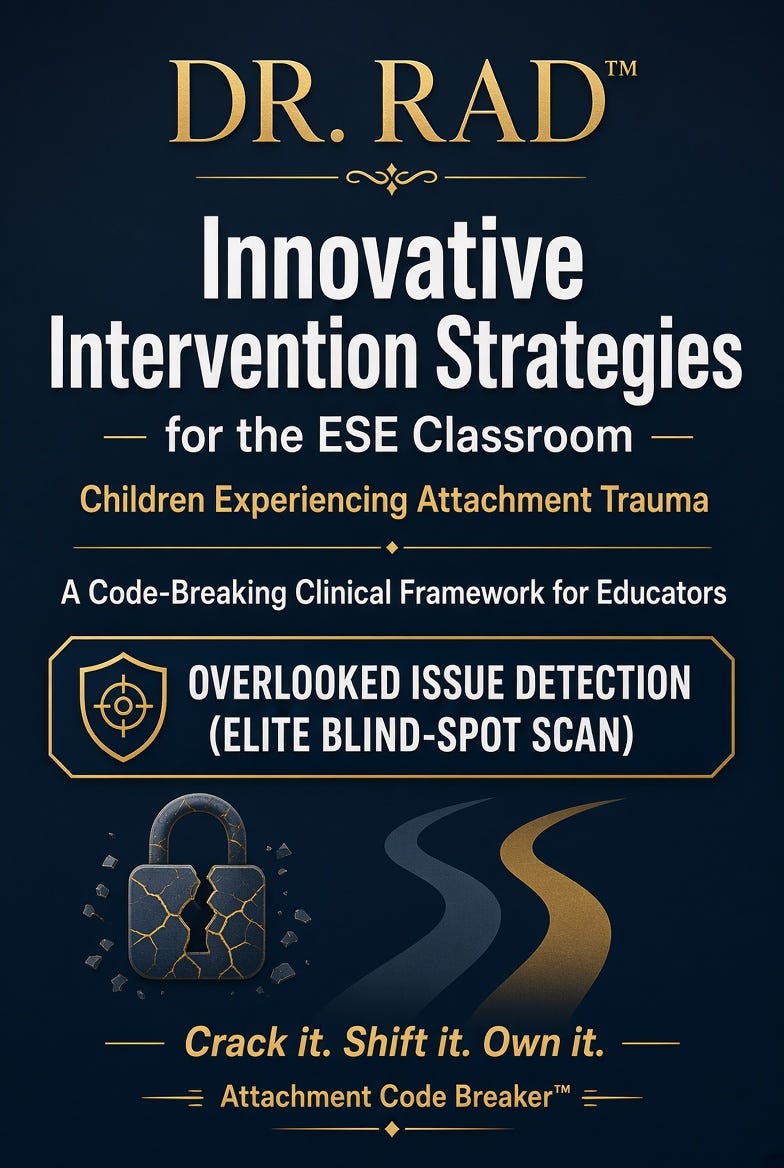
Innovative Intervention Strategies for the ESE Classroom
Children Experiencing Attachment Trauma
A Code-Breaking Clinical Framework for Educators
Overlooked Issue Detection (Elite Blind-Spot Scan)
The central overlooked concern mainstream ESE practice still misses:
Most ESE classrooms continue to treat attachment trauma primarily as a behavior-management or compliance problem. Token economies, point sheets, standard PBIS matrices, and pure cognitive strategies systematically fail because they ignore a core neurobiological reality: for the child with disorganized attachment or complex developmental trauma, the teacher is not experienced as a neutral authority figure. The teacher is experienced as a potential threat variable. Proximity to the primary adult in the room activates the child’s threat-detection system.
When the intervention stack is built only on external controls while the relational and regulatory architecture of the adult remains unaddressed, the classroom itself becomes Loop Fuel. The child escalates, the teacher becomes more controlling or more depleted, and the cycle hardens.
The clinically accurate, still under-taught truth:
The teacher’s regulated nervous system, predictable relational presence, and deliberate environmental structure are the primary intervention. Everything else is secondary.
This is not a soft insight. It is a forensic one.
Clinical Frame: Attachment Trauma in the ESE Setting
Children with attachment trauma enter the classroom with an internal working model organized around danger, unpredictability, and the expectation that adults will either abandon or overwhelm them. Their nervous systems are calibrated for hypervigilance or rapid shutdown. Standard classroom demands (transitions, group instruction, peer proximity, adult eye contact, corrective feedback) frequently exceed their Window of Tolerance.
ESE eligibility categories (Emotional/Behavioral Disability, Other Health Impaired, Specific Learning Disability, etc.) rarely capture the attachment architecture underneath the presenting behaviors. The result is a chronic mismatch between the intervention model and the actual neurological target.
The Attachment Code Breaker™ lens reframes the task:
We are not primarily trying to make the child “behave.”
We are trying to create the conditions in which the child’s nervous system can begin to update its prediction that adults are unsafe.
Innovative Intervention Strategies
Organized by Code-Breaking Layers
1. Regulatory Co-Construction as Primary Classroom Strategy
The teacher’s own regulated state is the most powerful co-regulatory instrument available in the room.
Practical applications:
Deliberate pre-regulation before the school day and before high-demand transitions (somatic reset, brief grounding, low-and-slow vocal preparation).
Use of neutral-and-low vocal tone and non-threatening body posture during corrective interactions (the Non-Reactive Response).
Planned “regulatory proximity” rather than constant hovering or complete withdrawal — the adult remains available without flooding the child’s system.
This is not self-care rhetoric. It is clinical technique. A dysregulated teacher cannot co-regulate a dysregulated child.
2. Predictability Architecture Inside the ESE Classroom
Unpredictability is experienced as threat. Structure is experienced as safety when it is consistent, visible, and non-negotiable.
Innovative practices:
Visual daily schedule that is followed with high fidelity and repaired within 24 hours when disrupted.
Pre-taught, limited Non-Negotiable Stack of classroom rules (5–7 maximum) stated in behavioral language.
Transition warnings delivered with the same language and timing every day.
“Return-to-structure” protocol after any disruption so the child receives repeated evidence that the container holds.
Predictability is not rigidity. It is an attachment intervention delivered through the environment.
3. Attachment Re-entry Windows in the School Day
Children with attachment trauma do not open relationally on demand. They open in brief, unpredictable windows when threat activation is temporarily lower.
Classroom translation:
Train staff to recognize low-threat moments (after successful task completion, during preferred quiet activities, in the first minutes after a regulated arrival).
Enter those windows with low-stakes, demand-free presence rather than academic or behavioral agenda.
Protect the window from immediate adult demand or peer intrusion.
These micro-moments accumulate. They are the school-day version of the Long Corridor.
4. Clinical Consequence Architecture (Not Punishment)
Standard point systems often become Loop Fuel because they are experienced as relational rejection or power struggle.
Shift to:
Pre-designed, proportional, time-limited consequences that include a clear recovery path.
Delivery in neutral tone with the three-sentence structure: behavior named → consequence stated → path back offered.
Separation of the child’s worth from the behavioral outcome.
The goal is environmental feedback that the child’s nervous system can eventually predict, not adult emotional reactivity.
5. Sensory and Physical Environment Design as Regulatory Support
Many ESE rooms are sensorially overwhelming for trauma-organized nervous systems.
Targeted adjustments:
Reduced visual clutter and harsh lighting.
Designated low-stimulation recovery space that is available without shame.
Preferential seating that reduces rear or side threat scanning.
Accessible, predictable movement breaks that do not require the child to “earn” regulation.
6. Educator Nervous System & Identity Protection (Vocation Layer)
Teachers working with this population absorb secondary traumatic stress at high rates. Depleted educators cannot sustain Level 1 relational work.
Required supports:
Explicit recognition that the work is clinical, not merely instructional.
Brief, protected recovery practices built into the duty day.
Peer consultation structures that prevent isolation.
Clear boundaries between the teacher’s identity and the child’s outcome.
A teacher who disappears into the crisis becomes another exhausted adult confirming the child’s internal model.
Snapped → Shifted → Solid™ Applied to the ESE Classroom
Snapped: The moment the teacher recognizes that traditional behavior systems are failing and the child’s presentation is attachment-driven, not purely willful.
Shifted: The deliberate move from control-based management to regulatory and relational architecture.
Solid: Consistent implementation of predictability, co-regulation, and clinical consequence structures until the classroom itself begins to function as a corrective relational environment.
There is no magic wand. There is only sustained, accurate, regulated practice over time.
Practical Classroom Tools (Immediate Implementation)
Teacher Pre-Regulation Checklist (2-minute somatic reset).
Visual Non-Negotiable Stack poster (behavioral language only).
Transition Script Card (same language every time).
Attachment Re-entry Window Observation Log (simple tally of low-threat moments and adult response).
Neutral Consequence Delivery Script.
Personal Educator Depletion Scan (weekly self-check on physical, emotional, cognitive load).
These tools are not decorative. They are the operational expression of the framework.
Closing Clinical Statement
Children with attachment trauma do not need more sophisticated point systems.
They need adults whose nervous systems are regulated enough, whose environments are predictable enough, and whose relational offers are consistent enough to begin rewriting a threat-based internal working model.
The ESE classroom can become one of the most powerful sites of that rewriting — but only when educators are equipped with the correct map.
The map is now in your hands.
Crack it. Shift it. Own it.
Bestselling Authors & Truth-tellers
Dr. Franklin Edward Shoemaker PhD (Psychology) | LMHC-QS | TF-CBT | Adoption Competent
&
Tonya A. Sharrett-Shoemaker MA (Counseling Psychology) | Certified Professional Educator (K-12 | K-5 | ESOL | 2024 Teacher of the Year – Medulla Elementary)
34 years providing Expert Insights.
FACTS. FOCUS. FIRE.
Dr. RAD The Attachment Code Breaker, P.L.L.C.
SNAPPED | SHIFTED | SOLID – Elevating Trauma to Trust
(Mr. Ed’s Circle of Trust, Inc.)
Crack it. Shift it. Own it.
Connect:
DrRADTheAttachmentCodeBreaker.Substack.com
TheDrRADLibrary.Substack.com
4404 S. Florida Ave. Suite 14
Lakeland, Florida 33813-2124
DrRAD@DrRADTheAttachmentCodeBreaker.com
Mobile/Text: (863) 899-2162
Fax: (850) 270-6733